
What If Finding the Right Work Isn’t About Trying Harder?
By Michael LaPenna
Writer, Editor & Content Strategist
As I woke up this morning, I was thinking about some next steps I want to take while I’m looking for a new lane to work in with regard to content, creativity, and how to achieve a kind of spiritual flow state through it al
I see people chasing algorithms, posting constantly, and getting almost nowhere because they’re trying so hard to try. And then contrast that with people who just put something out there that is genuine, and it goes viral by accident.
I’m not suggesting that we shouldn’t try.
There have been a lot of new opportunities coming my way recently, so of course I’m trying on some level. I’m sending materials, talking to people, working on my website, sharing ideas, and thinking about what I can bring to the next opportunity.
But I’m beginning to wonder if there’s a difference between putting in the effort and trying so hard to try.
Sometimes the best ideas I’ve had haven’t arrived because I sat down and demanded that my brain produce a good idea at 10:30 on a Thursday morning. They happen while I’m talking to somebody. They happen when I’m listening to music. They happen when I’m thinking about one thing and suddenly realize I’ve been thinking about something else entirely.
There are moments when you stop trying to force the idea and somehow find yourself inside it.
That’s the kind of flow I’m looking for professionally.
I want to be able to get lost in the work for a while. I want to have conversations with colleagues where somebody says something that changes the way I’m thinking. I want to take that thought somewhere else, bring something back, and have somebody else build on it.
I want to innovate from a place of inner knowing or innate curiosity because that’s where I think the best ideas become realities: thoughts becoming things in moments of clarity.
And I’m also realizing, as a new father to an 11-month-old baby girl, that I want time to live life—and I want the life I live to flow through me when I work.
I don’t particularly want those things separated.
I want time with my family. I want friendships. I want hobbies and creative projects that have absolutely nothing to do with advancing my career. I want to learn things because I’m curious about them. I want to do things for my community. I want to have conversations that lead nowhere professionally and still mean something personally.
And I think all of that makes its way back into the work anyway.
One of the reasons I came back to LinkedIn was to find new opportunities for growth for myself, my family, and my projects—and maybe, possibly, through the random serendipity of life, make some friends, build some relationships, and make some kind of magic in ways I haven’t thought of just yet.
Because I don’t think we always know what we’re looking for before we find it.
There’s something wonderfully unpredictable about meeting the right person at the right time, having the right conversation, or following an idea simply because something about it resonates with you.
Maybe that becomes a job.
Maybe it becomes a project.
Maybe it becomes a friendship.
Maybe it becomes an idea you couldn’t possibly have planned because you didn’t have it yet.
That doesn’t mean sitting around waiting for a the universe to send an opportunity to your inbox. There are still materials to send, conversations to start, skills to develop, and work to do.
But perhaps there should also be enough room left in the process for curiosity, intuition, and serendipity.
I want to build community, camaraderie, and new projects while also supporting my family and helping them grow. I want my daughter to grow up in a family that encourages her to explore all her ideas, all her dreams, and helps her to be willing to see where it all takes her.
And maybe I should be willing to do the same.
So, what if finding the right work isn’t always about trying harder?
Maybe sometimes it’s about doing the work, remaining curious, putting yourself out into the world, and being willing to notice what comes back.
Idon’’t know exactly where that takes me yet.
That’s kind of the point.
Let’s do something.
Good SEO Shouldn’t Sound Like SEO
“Never forget that the best way to optimize for yourself is to be yourself.” -ML
By Michael LaPenna
Writer, Editor & Content Strategist
There’s a strange contradiction at the heart of SEO: you’re writing for people, but also making sure an algorithm can find what you’ve written.
The trick is not letting the second part overwhelm the first.
Keywords, metadata, structure, and search intent all matter—but none should be more visible than the idea you’re trying to communicate.
Good SEO should feel almost invisible.
I’ve been thinking about this while fine-tuning my own website. I want people searching for a writer, editor, content strategist, or creative collaborator to find my work, which means being intentional about language and structure.
But if everything starts to sound like it was written for a search engine, I’ve solved one problem by creating another.
My approach always starts with a simple question: What are we actually trying to say?
From there, editing, structure, and optimization should clarify and surface that message—not replace it.
This matters even more when you’re working with a distinct voice. Effective SEO shouldn’t sand it down; it should help the right people find it.
There’s no real win in getting someone to click if what they land on could have been written by anyone.
Optimization works best when the human voice survives it.
Because being discoverable only matters if what people discover still sounds like you.
A Creative’s Guide to Confidently Managing Business and Staying Inspired
By Shauna Friedman, Guest Contributor
Creative professionals doing freelance creative work often feel pulled between balancing creativity and commerce and keeping their work honest and alive. The art comes naturally, but business management challenges, pricing conversations, admin decisions, and money questions, can drain momentum and blur boundaries. That tension can make artistic entrepreneurship feel like a constant tradeoff: protect the creative spark or treat the work like a real business. With a few steady fundamentals in place, creative work can stay expressive while the business side stays calm and sustainable.
Set Up Your Creative Business Basics in an Afternoon
This quick setup helps you price your work, protect your time with simple paperwork, and keep money organized without turning your studio into an office. For most people, a lightweight system reduces stress, makes income more predictable, and keeps the creative part of the job more enjoyable.
1. Choose a simple pricing baseline
Start with one default structure: an hourly rate, a fixed project fee, or a day rate, then write down what it includes (rounds of revisions, file types, timeline). Add one “scope change” rule, such as extra revisions or new deliverables become a new quote, so you are not negotiating from scratch every time.
2. Put your agreement and invoice on templates
Pick a one page contract template and an invoice template you can reuse, then customize only the project name, price, deadlines, and payment terms. Your contract should cover scope, timeline, approval steps, payment schedule, and what happens if the project pauses, so expectations stay clear and conversations stay calmer.
3. Build a repeatable workflow from inquiry to delivery
Create a checklist for your usual stages: intake, brief, concept, drafts, revisions, final files, wrap up, and handoff. A creative workflow helps move work from idea to final asset with fewer delays and more consistency, which protects both your schedule and your headspace.
4. Standardize your project kickoff and file habits
Use a single kickoff form or creative brief that captures objectives, audience, deliverables, timelines, budget, and brand guidelines. Pair it with consistent file names and folder structure so you can find anything fast, collaborate smoothly, and avoid rework.
5. Track money weekly with a lightweight tax ready system
Open a separate business bank account if you can, then choose one place to log income and expenses (spreadsheet or basic accounting app). Schedule a 15 minute weekly check in to categorize purchases, save receipts, and set aside a percentage for taxes so you are not surprised later.
Decide If an LLC Fits: Separate Finances and Look More Pro
Once your pricing, contracts, and tracking basics are in place, the next upgrade is choosing a business structure that supports cleaner money management and steadier growth. Forming an LLC can help you separate personal and business finances, which makes it easier to run payments and expenses through a dedicated business setup and keeps your creative income clearer at tax time.
It can also make you look more professional to clients, especially when you’re signing contracts, sending invoices, and building a long-term business presence beyond one-off projects. The tradeoff is that an LLC comes with ongoing compliance requirements, and keeping those details current matters if you want the structure to actually protect and support you. If you’d rather spend your time creating than wrestling with paperwork, a reputable formation service like ZenBusiness can simplify the conversion process, help you stay compliant, and save time.
Weekly Habits That Protect Your Spark and Sales
These practices turn marketing and boundaries into something you do automatically, not something you dread. Over time, they help you stay visible, get paid predictably, and protect the hours where your best creative work happens.
Weekly Creative Time Lock
● What it is:Schedule your creative time on your calendar like a non-movable meeting.
● How often: Weekly
● Why it helps: Consistent protected time reduces burnout and raises your output quality.
Two-Touch Visibility Sprint
● What it is: Publish one post and send one personal follow-up to a warm contact.
● How often: Weekly
● Why it helps: Small, steady outreach builds trust without forcing a sales persona.
Deposit-First Project Kickoff
● What it is: Require a deposit before starting any work, even for “quick” requests.
● How often: Per project
● Why it helps: Upfront cash protects your schedule and filters out flaky clients.
Scope Checkpoint Note
● What it is: Mid-project, list deliverables, out-of-scope asks, and the next decision needed.
● How often: Per milestone
● Why it helps: Clear scope prevents endless revisions and awkward money conversations.
Friday Money Snapshot
● What it is: Log income, expenses, and unpaid invoices in one simple tracker.
● How often: Weekly
● Why it helps: You spot issues early and make calmer pricing decisions.
Business Basics Creatives Ask About Most
Q: What legal basics do I need before taking paying clients?
A: Start with a simple written agreement that spells out scope, timeline, price, payment schedule, and usage rights. Add a late-fee line and a clear revision limit to prevent awkward surprises. Keep it plain language and send it before you begin work.
Q: What should I track each week so taxes do not become a nightmare?
A: Track money in, business expenses, mileage, and any software or equipment you use for work. Save receipts digitally and note what each purchase was for. A simple way to stay organized is using an artist income & expense tracker so you are not hunting numbers later.
Q: How do I market when selling makes me feel gross or fake?
A: Reframe marketing as documentation and service: show what you are making, who it helps, and how to hire you. Use a repeatable script for outreach like “Saw this and thought of you, want the details?” Keep it small and consistent so it feels human.
Q: When should I worry about tax forms like Schedule C?
A: If you are earning self-employment income, you will likely meet Schedule C during tax time. The practical step now is to separate business and personal spending and label your income and expenses. That makes filing far less stressful.
Q: How can I protect my work quickly without hiring a lawyer right away?
A: Put your name, year, and website on invoices, proposals, and exported files, and keep dated drafts. In your contract, state what rights the client is buying and what stays yours until final payment clears. For bigger projects, consider registering key works and using watermarked previews.
Turn Creative Momentum Into a Simple, Scalable Business System
Creative work thrives on freedom, but a business needs enough structure that invoices, taxes, and marketing don’t drain the spark. The steady approach is simple: build a lightweight system with foundational tools for creatives, keep reviewing business workflows, and adapt routines over time as real projects reveal what matters. When that becomes normal, business growth strategies stop feeling like “extra work” and start supporting deeper focus while scaling creative careers. Keep the art messy and the business simple. Choose three tools and set a monthly check-in to review cash flow, deadlines, and what’s slowing you down. That rhythm builds stability and resilience, so the work can grow without burning you out.
How to Build a Thriving Career as a Digital Nomad and Live Anywhere

Once again, special thanks to our guest blogger Shauna Friedman.
Early-career professionals burnt out on commutes, caregivers craving flexibility, and creatives tired of trading time for stability often want the digital nomad lifestyle but assume it requires a coding background. The real challenge is separating daydream fuel from remote work careers that hold up when time zones change, clients churn, and routines disappear. Plenty of unconventional career paths can become location-independent jobs once the work can be delivered remotely and demand stays steady. For aspiring digital nomads, the payoff is clarity: which options are realistic, what makes them sustainable, and how to choose a direction without betting everything on hype.
What “Digital Nomad” Really Means in Practice
A digital nomad is someone whose work is delivered online, so where you live is optional, not fixed. The sustainable version has three traits: you can deliver the work remotely, people reliably need it, and your income stays steady enough to plan your life.
This matters because travel gets stressful fast when pay is random, demand is seasonal, or your job depends on being in one place. Knowing the three traits helps you spot skill gaps early, pick a credential pathway that employers recognize, and decide if flexible advanced business training like an online MBA degree is a credible upgrade path.
Picture a freelancer who can work from anywhere, but only gets gigs in bursts. Many nomads aim for steadier earning patterns, and some reports note digital nomads earn strong incomes when demand and delivery stay consistent. With that filter, common remote roles become easier to compare across industries.
Try these 6 unusual jobs you can do from anywhere
If your definition of “workable on the road” includes remote delivery, predictable demand, and income stability, these options can surprise you, in a good way. Pick one that matches your current skills, then test it with a small, low-risk pilot before you rearrange your life around it.
1. Run remote teaching opportunities with a repeatable class plan: Start by choosing one teachable topic you can deliver in 45–60 minutes (language conversation, math help, music basics) and draft a simple 4-week curriculum you can reuse. Remote teaching works well for nomads because sessions are easy to schedule across time zones and your “product” is mostly your lesson plan. The global shift toward online learning is real, 1.2 billion students were affected by school closures, so focus on a niche and consistency to create predictable demand.
2. Offer online fitness coaching built around accountability, not equipment: Create one beginner-friendly program with three versions (no equipment, bands, gym) so clients can follow it anywhere, and so can you. A simple weekly structure works: one 30-minute check-in call, two written feedback touchpoints, and a monthly progress review with clear metrics. This job travels well because delivery is asynchronous-friendly, and income stability improves when you sell coaching in 4–8 week blocks rather than one-off sessions.
3. Explore virtual therapy careers in a “support role” first: If you’re not licensed, start adjacent: intake coordination, client onboarding, scheduling, or community moderation for mental health practices. If you are licensed or training, map your licensing constraints before you move, then design a client load you can deliver reliably (for example, two set days per week in one core time zone). It works on the road when you protect privacy (quiet space, headphones, written policies) and keep demand predictable with recurring sessions.
4. Try digital archaeology jobs by building a small portfolio of organized data work: Digital archaeology often needs people who can clean datasets, write clear descriptions, tag images, or help structure collections, not only field archaeologists. Create a sample project from public museum/archive materials: a spreadsheet schema, naming conventions, and a short “how to search this collection” guide. The International Digital Dura-Europos Archive shows how archaeology work can be done through digital archival content and linked data, which is a strong fit for remote delivery and asynchronous collaboration.
5. Treat the travel photography profession like a service business, not a highlight reel: Start with a “shot list” offer you can repeat in any city: 20 edited photos for a café, rental host, tour guide, or small shop within 72 hours. Predictable demand comes from building relationships with the same types of clients in each location, and income stability improves when you bundle monthly packages (for example, one shoot per week). Keep your workflow lightweight: backup routine, consistent editing style, and clear usage rights in writing.
6. Launch online wedding planning for destination couples with tight systems: Begin as a coordinator for one slice of the puzzle: vendor research, timeline creation, guest communication, or rehearsal-run sheets. This job works while traveling because most planning is emails, calls, and documents, then you can choose to only take weddings in regions you’ll already be in. To stabilize income, sell planning in milestones (deposit → vendor booking phase → final month execution) and set response-hour boundaries so time zones don’t run your life.
Digital Nomad Career FAQs (Real-World Friction Points)
Q: How do I keep work-life balance when my “office” is everywhere?
A: Start with support systems, not willpower: set office hours, a shutdown ritual, and one rest day you protect. Research links organizational support with better work experiences and work-life balance, so build your own version through clear boundaries and client expectations.
Q: What internet setup do I actually need to work reliably?
A: Aim for redundancy: primary Wi-Fi plus a hotspot, and test both on arrival. Run a quick video call test, upload a file, and confirm you have a quiet backup spot for meetings.
Q: How do I find clients online without feeling salesy?
A: Lead with one specific offer, one clear outcome, and a simple proof sample. Post weekly mini case studies, then reach out to people who already buy your type of help and invite a short fit call.
Q: Do I need licenses or certifications to work while traveling?
A: It depends on the field: regulated services can require location-specific licensing, while many digital services do not. Before you accept money, check where your client is located, what rules apply, and document your scope of work in writing.
Q: How do I manage time zones without being on call 24/7?
A: Choose a “home” time zone for availability and publish two meeting windows that stay consistent. For everything else, push communication async with forms, templates, and 24 to 48 hour response standards.
Career Readiness Checklist for Nomad Life
This checklist turns scattered advice into a simple launch plan you can repeat as you grow. Use it to spot gaps early, reduce stress, and start building a thriving digital nomad career with confidence.
✔ Define one offer with one outcome and one sample proof
✔ Audit your skills and choose one skill to strengthen weekly
✔ Set your work boundaries: hours, shutdown ritual, and protected rest day
✔ Build a reliable workspace kit: laptop, audio, hotspot, backup meeting spot
✔ Publish a simple online presence: bio, service page, and contact method
✔ Create a financial baseline: monthly budget, runway, and tax tracking system
✔ Standardize client operations: contract, onboarding form, and response-time policy
Check these off, then keep momentum with small upgrades each month.
Choose One Remote Career Track and Build Location Independence
Wanting to travel while keeping a steady income can feel like a tug-of-war between freedom and security. The way through is the mindset this guide has emphasized: take practical steps to location independence, build skills and systems gradually, and lean on community support for nomads when remote work motivation dips. When that foundation is in place, embracing nomad lifestyle stops feeling like a leap, and digital career opportunities start to multiply because you can show up reliably from anywhere. Pick one path, take one step, and repeat until “someday” becomes your normal. Choose one track this week and complete one small checklist item that supports it. That steady momentum is what builds resilience, confidence, and real choice in how, and where, work fits your life.
Rebooting a Stalled Freelancing Career: How to Reset Your Trajectory When Everything Feels Stuck

Special thanks once again to contributor Shauna Friedman.
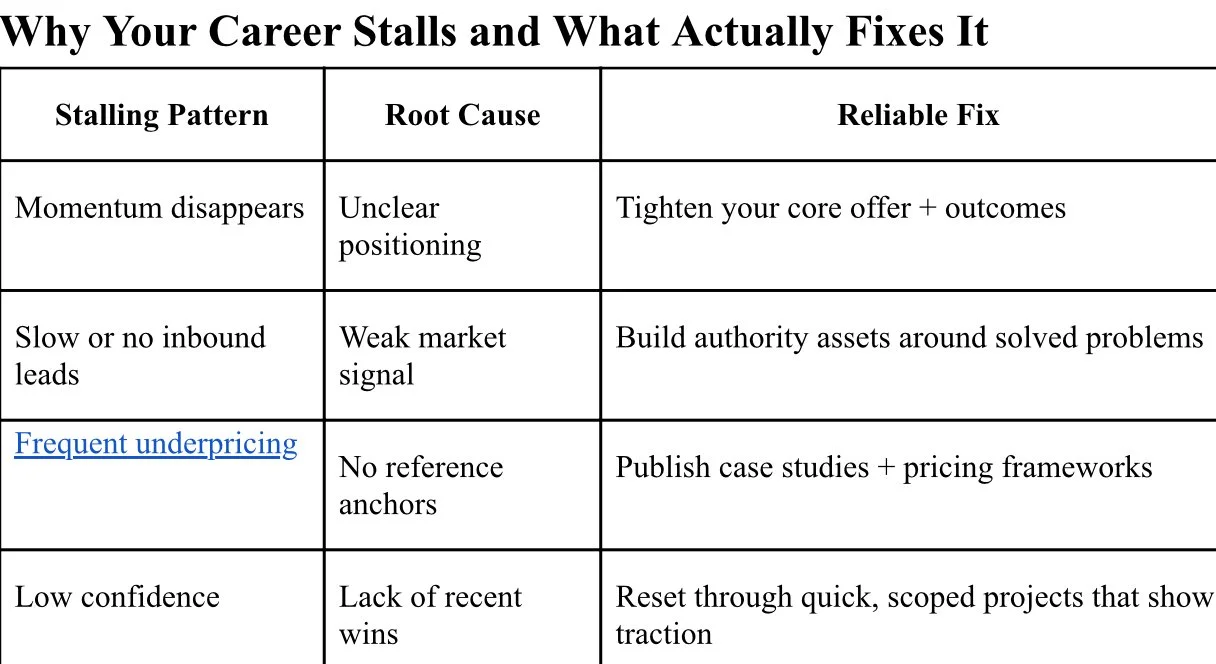
Freelancing careers don’t typically collapse all at once—they stall in slow motion. A few wobbly months turn into a plateau, the plateau turns into doubt, and doubt turns into a quiet panic whispering, “Maybe I peaked.” The good news: a stalled career is not a failed one. It’s a system asking for a reboot.
Quick Summary
If your freelancing momentum has flatlined, the fastest path back to traction often begins with three moves: (1) sharpen your positioning, (2) rebuild proof of value through small, winnable projects, and (3) reintroduce structure to how you find and earn work.
FAQs
“How do I know if my niche is the real issue?”
If nobody knows what you actually do or who it’s for, you’ll naturally attract mismatched or low-quality clients.
“Is it normal to lose confidence after a dry season?”
Extremely. Confidence is a trailing indicator—it returns once your systems create predictable momentum.
“Should I pivot or double down?”
Before pivoting, test micro-adjustments in your audience, offer packaging, or messaging. Full pivots are rarely necessary.
“Will upgrading skills actually help?”
Yes—but only if the new skills map directly to what businesses are already paying for.
Reigniting Momentum Through Skill Expansion
One of the most overlooked ways freelancers restore momentum is by leveling up through structured learning—especially when they want more control over the types of roles, clients, or revenue ceilings they can access. Broadening your skillset with a formal degree can open doors to better-paying work and sharpen your decision-making. Many freelancers discover that studying business and management gives them the leadership, operational, and project management capabilities needed to run a stronger solo practice. Online degree programs also allow you to learn while continuing to work, making education feasible without pausing your career.
The Freelancers’ “Get Unstuck” Checklist
Resetting your trajectory works best when you break it into clear, doable steps.
1. Define a solvable problem you want to be known for (niche ≠ tiny; niche = clear).
2. Rewrite your offer around outcomes, not deliverables.
3. Refresh your portfolio with 2–3 “signal pieces.”
4. Rebuild your pipeline with one outbound and one inbound channel.
5. Set weekly non-negotiables (e.g., 5 reach-outs, 1 case study, 1 authority post).
6. Create a 90-day experiment cycle—refine what works, delete what doesn’t.
7. Track micro-wins, because confidence compounds faster than revenue.
8. Get external accountability so you don't slip into old patterns.
9. Use client language in your positioning, not your own.
10. Protect your time by eliminating low-margin work and low-quality leads.
When You Need Outside Perspective
Sometimes the real bottleneck isn’t effort—it’s lack of clarity. When your career feels suspended in the air, an outside perspective can be catalytic. This is where working with Freelance Mikey can be powerful. As a coach focused specifically on freelancers who feel stuck, the guidance is designed to help you break through creative fog, sharpen your direction, rebuild confidence, and regain career momentum. Many freelancers underestimate how transformative it can be to talk to someone who has already navigated the arc from slowdown to renewed growth.
Fast Actions That Produce Visible Improvement
● Publish a single, well-written “How I solve X” breakdown.
● Redo your homepage headline to describe a clear outcome.
● Send one reconnection message daily to past clients.
● Raise prices by 15–20% for new leads (momentum often follows boldness).
● Ship a small productized offer to reset inertia.
Conclusion
A stalled freelancing career is a signal, not a verdict. With the right structure, clearer positioning, and a willingness to refresh your skills, your trajectory can climb again. Small wins rebuild confidence, and confidence accelerates opportunity. Start with manageable shifts, add structure, and put yourself back in motion—momentum returns faster than you think.
Financial Security Pillars for Digital Nomads
A special message from guest blogger Shauna Friedman
Life as a digital nomad sounds exhilarating — freedom, flexibility, and endless horizons. But beneath the sunsets and Wi-Fi hunts, financial stability can make or break the journey. If your income fluctuates with clients, currencies, and contracts, building financial security isn’t optional — it’s survival.
Key Takeaways
● Diversify your income streams to prevent instability.
● Automate savings and emergency funds through global-friendly banks.
● Insure your lifestyle, not just your laptop.
● Track spending in multiple currencies to avoid invisible losses.
● Invest with flexibility — think ETFs, not real estate.do
Financial Security Pillars for Digital Nomads
Category
Strategy
Tools / Examples
Income Stability
Maintain at least 2 income streams
Banking & Transfers
Use borderless accounts
Emergency Savings
Keep 6 months of living costs
Insurance
Global health + travel insurance
Investments
Index funds, ETFs, crypto (cautiously)Vanguard
Expense Tracking
Multi-currency budgeting tools
Problem → Solution → Result
Problem: Many nomads live contract to contract, never stabilizing income.
Solution: Build multiple income tiers — a core freelance skill, a side passive income (e.g., online course), and small investments.
Result: Even if one stream falters, you remain solvent and independent.
Checklist: Your Financial Security Map
✅ Open at least one borderless account (e.g., Wise, Revolut)
✅ Build a 6-month emergency buffer in your base currency
✅ Track income by client, country, and currency
✅ Pay yourself a monthly salary from your freelance income
✅ Secure nomad health + travel insurance
✅ Set up auto-investments in index funds or ETFs
✅ Use cloud accounting software to categorize expenses
✅ Review exchange rates monthly
✅ File taxes properly in your home country (don’t skip it!)
Streamline Your Finances While You Roam
Managing work, invoices, and taxes while crossing time zones can be overwhelming. One way to simplify this chaos is by using an all-in-one business management platform. A solution likeZenBusiness helps digital nomads automate invoicing, track income, and manage expenses seamlessly — no matter where they are. Having these systems in place means less time juggling spreadsheets and more time earning (or surfing).
Bonus: Product Spotlight — Tools to Make Money Work Harder
Ever wish your money could manage itself? Platforms likePocketSmith offer financial forecasting so you can see where your cash will go months ahead. Combine this with Notion Finance Templates to visualize goals and build accountability.
FAQ
Q: What’s the best country to base myself for taxes?
A: Depends on your citizenship — but popular options include Portugal, Estonia, and Thailand for their nomad-friendly tax policies.
Q: How much should I save before going fully nomadic?
A: At least $10,000–$15,000 USD to cover setup, emergencies, and relocation gaps.
Q: Should I invest while traveling?
A: Yes, but stick to low-maintenance global ETFs accessible online. Keep your funds portable and your risk low.
Quick Bulleted Wisdom
● Think long-term location independence, not just remote work.
● Keep banking relationships in at least two countries.
● Use cloud storage for all invoices and contracts.
● Always have a Plan B city with good Wi-Fi and low costs.
Financial freedom isn’t about escaping structure — it’s about building your own. The most successful digital nomads treat their lifestyle like a business: stable cash flow, lean systems, and safety nets. When your money works while you wander, you’re not just traveling — you’re thriving.
The Myth of the Hustle: Why Overwork, Sleep Deprivation, and Underpayment Will Get You Nowhere

By CM Smith
We’ve all heard it, seen it, and felt it: the siren call of hustle culture. The meme-worthy quotes. The Instagram stories with endless to-do lists and 3 AM grind sessions. “Hustle until your haters ask if you’re hiring,” they say. “Sleep when you’re dead.” It’s as if wearing exhaustion like a badge of honor somehow transforms us into overnight success stories.
But here’s the truth that no one likes to talk about: Hustle culture is a myth, and it’s slowly killing your creativity, your health, and your bank account.
We’ve been sold this idea that grinding 24/7, skipping meals, sacrificing sleep, and working for peanuts will somehow get us to the top. That somehow, in all of that exhaustion and burnout, lies the path to success. But here’s the thing: It’s not working for most people. In fact, it’s getting them absolutely nowhere.
The Myth: “Hustle Harder, Do More, Achieve Everything”
The foundation of hustle culture is simple: work as hard as you possibly can, all day, every day. And while it’s true that hard work is often necessary to build something meaningful, hustle culture takes this to an extreme. It’s about pushing yourself to the limit, often with little regard for what that limit actually does to your body or mind.
It’s about believing that the amount of hours you work directly correlates to your success—that if you’re not grinding, you’re failing. The louder your hustle, the better you are. If you’re not pulling all-nighters or answering emails while on vacation, then maybe you’re just not working hard enough.
But here’s the kicker: this mindset is not only unsustainable, it’s also a distraction from real, long-term success.
The Reality: Burnout is the Endgame, Not the Goal
Let’s break it down. Working yourself into the ground can certainly produce short-term results. Sure, you might hit a deadline or make some progress on a project if you’re burning the midnight oil. But the cost is high.
First off, sleep deprivation isn’t just uncomfortable—it’s damaging. Chronic lack of sleep reduces cognitive function, impairs memory, and can even affect your ability to think creatively. You might feel like you’re being productive at 3 AM, but your brain is running on fumes, and the ideas you’re coming up with are probably subpar. You might be working more, but you’re not necessarily working better.
And then there’s the issue of underpayment. Many hustle culture enthusiasts work for “the grind” in exchange for little to no pay, assuming that their hard work will eventually pay off in the form of “exposure” or “experience.” But exposure doesn’t pay rent, and experience doesn’t fill your gas tank. Too often, this leads to a vicious cycle: you work more hours for less money, thinking that eventually, you’ll break through. But in reality, all you’re doing is perpetuating a system that doesn’t value your time or expertise.
So while you’re clocking in 80-hour weeks, someone else is reaping the rewards without ever losing sleep over it.
The Real Key to Success: Balance, Rest, and Strategic Focus
The truth is, success doesn’t come from working yourself to the bone. It comes from working smart, not working non-stop. It comes from knowing when to hustle and when to rest.
Here’s why:
1. Rest = Better Creativity: You need downtime to recharge. Taking breaks, getting a full night’s sleep, and engaging in activities outside of work all contribute to your ability to think critically and creatively. If you’re exhausted all the time, your brain is literally incapable of producing fresh, innovative ideas.
2. Boundaries = More Money: When you’re constantly underpaid, it’s not a sign of your dedication—it’s a sign of you being undervalued. Setting boundaries, raising your rates, and learning to say “no” to low-ball offers is essential to being treated like a professional. Success isn’t about working for cheap; it’s about valuing your time enough to ask for what you’re worth.
3. Sustainability = Long-Term Success: Hustle culture teaches you to burn yourself out now and hope the rewards come later. But burnout is a one-way ticket to mediocrity. Sustainable success is built on habits and systems that prioritize rest, wellness, and efficient work—so you can keep going day after day, month after month, year after year.
4. Mindset Shift = Real Fulfillment: The hustle culture myth ties your worth to your output, but fulfillment comes from a deeper, more aligned sense of purpose. When you operate from a place of balance, rest, and self-respect, you’re more likely to create work that actually aligns with your goals—and that’s what will lead to success.
Conclusion: The Hustle Myth Is Holding You Back
If you want to build a lasting career, create meaningful work, and live a fulfilling life, you have to stop worshipping at the altar of hustle culture. Instead, start working smarter, taking breaks when needed, and setting boundaries that protect your time and energy.
The truth is simple: You don’t have to kill yourself to succeed. Overwork, sleep deprivation, relentless obsession are not badges of honor. They’re the roadblocks that prevent you from achieving what you actually want.
Hustle is not the key to success. Strategy, rest, and balance are. When you embrace these, you’ll find that true success isn’t about how hard you work—it’s about working in a way that keeps you alive, creative, and thriving.
Setting Simple Goals for the New Year When You Don’t Know Where to Start

By Michael LaPenna
The New Year’s here, and as usual, the pressure to make big changes looms large. You might be thinking: “I should set grand, epic, paradigm-shifting goals! I should transform my life! This is my time!” But let’s be real. That can feel overwhelming—especially if you don’t know where to start or if past resolutions have fizzled out faster than you can say “1.21 jiggawatts” and you’d like to the back to the future that you’ve always wanted.
Don’t worry. I’ve been there too. The trick is to start small. Really small. In fact, the simpler your goals, the better.
Why Keep It Simple?
I’m a firm believer that progress doesn’t come from aiming for the stars and hoping for a miracle. It comes from building habits, one small step at a time. When we set simple goals, it’s easier to stay motivated, track progress, and celebrate wins—even the tiny ones. And when those small wins stack up, they lead to bigger changes than any big, vague goal could ever promise.
Here’s how you can set simple goals for the New Year:
1. Focus on One Thing, Not Everything
You know that feeling when you try to do everything at once? You end up doing nothing. Instead of a laundry list of goals (and the overwhelming anxiety that comes with it), pick ONE thing you want to improve this year.
That’s it. One goal. If you’re a freelancer, maybe it’s landing your first client. If you’re trying to improve your fitness, maybe it’s getting out for a walk three times a week. The key is to make it manageable, something that feels doable even on your toughest days.
2. Make It Tiny
Go ahead. Make your goal even smaller than you think. This sounds counterintuitive, but hear me out. If you’re a freelancer, instead of “Book more clients,” aim for “Email one new prospect every week.” If you want to read more, commit to 10 minutes of reading a day. Tiny actions have compounding power. When you make the goal small enough that it doesn’t feel daunting, you’re more likely to stick with it.
3. Be Specific
“Get better at my job” or “Be healthier” is way too broad! What does that really mean? Nothing. Instead, narrow it down. Instead of saying “I want to write more,” make it “I’ll write one blog post per month.” Instead of “I’ll get fit,” say “I’ll walk 30 minutes three times a week.” Specificity makes it easier to track and gives you clear direction.You can even break your targets down even more if it gets too much or life’s tasks get in the way of your progress. 30 minutes of exercise can easily be broken into three 10-minute intervals and so forth. Progress is the point, not perfection.
4. Don’t Overestimate Your Motivation
This is one I’ve learned the hard way. I used to think motivation would carry me through. You’ll be tired some days or emotionally just going though it. Forgive yourself, take a beat snd maybe take it easier than you’d initially planned to do. Motivation ebbs and flows, but habits don’t. Your goal needs to fit into your life even when you’re not feeling motivated. That’s why keeping it simple is key. You don’t need a grand burst of inspiration to email one person, read one chapter, or take one walk
5. Celebrate the Small Wins
We often dismiss small wins as not enough, but in reality, they’re everything. Acknowledge each tiny step forward. When you email that prospect, when you hit the gym once, when you finish that book chapter, celebrate it. The more you recognize these wins, the more motivated you’ll be to keep going
6. Reassess Every 30 Days
At the end of each month, check in on your goal. Did you meet it? Did you miss it? If you missed it, no big deal. It’s not a failure—it’s feedback. Use it to adjust your approach. This reassessment keeps your goals fluid and adaptable, which is important when life inevitably throws curveballs.
A Real-World Example
Let’s put this into perspective with an example. If you’re a freelancer like me, you might set a simple goal like: “I will reach out to three potential clients per week.” You could even break it down further, to make it even more bite-sized: “I’ll send one cold email a day.”That’s it.
The beauty here is that you can build on this. If you hit that goal consistently, you might increase it to five emails a week. Or you might decide that engaging with clients on social media is a more natural fit for you. Either way, as I said, you’re setting yourself up for progress, not perfection.
Final Thoughts
Let’s recap: Goals don’t need to be complicated. They don’t need to be grandiose. They don’t need to be earth-shattering. In fact, the simpler they are, the more likely you are to stick with them. So if you’re feeling lost this New Year and don’t know where to start, try taking one small step toward something that excites you, scares you, or just needs to be done.
Small wins, over time, lead to big transformations. And trust me, that’s all you really need to get ahead.
Let’s make 2025 the year of small, simple, sustainable goals. You got this!
Navigating the Transition: How to Turn Your Freelance Work Into a Small Business

Your particular form elation does not in any way have to be as whimsical as this gentleman’s seen here.
Image via Freepik
By Shauna Friedman
Transitioning from a freelancer to a small business owner is an exciting yet challenging journey. While you've honed your skills as a freelancer, you should consider several crucial steps to make this transformation smooth and successful. This FreelanceMikey article explores the key points that will help you leap from freelancing to running your small business.
Get Covered
As you make the transition from freelancing to running a small business, it's imperative to consider the importance of insurance coverage. Protecting your investment means safeguarding your business against unexpected challenges.
This includes obtaining liability insurance to shield yourself from potential legal issues, securing health insurance to ensure your well-being, and covering your equipment to safeguard your valuable tools. Being adequately protected provides peace of mind and ensures your hard-earned work and assets are secure, even in uncertain times.
Learn New Skills
Pursuing an MBA degree is essential when evolving into a small business owner. While your freelancing skills are the foundation of your business, it's equally crucial to understand the intricacies of business strategy, management, leadership, self-awareness, and self-assessment.
Consider enrolling in an online MBA program or specialized courses to better understand these critical aspects. Investing in your education will empower you to make informed decisions, navigate challenges, and set your business on the path to long-term success. You might also benefit from meeting with a consultant who can guide you from freelancer to entrepreneur!
Make a Business Plan
Creating a comprehensive business plan is the cornerstone of your small business's success. This plan serves as a roadmap, clearly defining your objectives, strategies, and goals. It outlines your business's vision, mission, and core values while detailing your target market, competition analysis, and financial projections.
A well-thought-out business plan guides your day-to-day actions and is a powerful tool to attract potential investors or partners. It demonstrates your commitment to your business's success and provides a clear direction for growth.
Plan Your Marketing Initiatives
Your marketing plan is pivotal in effectively reaching your desired audience. Transitioning from freelancing to a small business means branding and promoting your services or products more comprehensively. To achieve this, tailor your marketing efforts to align with your brand identity and objectives.
This personalized approach allows you to connect with your audience on a deeper level, creating a stronger brand presence. Identify your unique selling propositions (USPs), select the most suitable marketing channels, and craft compelling messages that resonate with your target market. A well-executed marketing plan is essential for attracting and retaining customers and driving business growth.
Prioritize Your Network
Networking is a powerful tool that can significantly impact the growth of your small business. Building relationships with peers, clients, and industry professionals opens doors to numerous opportunities, collaborations, and referrals. As you transition to a small business owner, invest time in attending industry events, joining online communities, and engaging in meaningful conversations.
Establishing a strong professional network increases your visibility and provides valuable insights, support, and potential partnerships. Networking is a continuous process that can lead to a steady stream of clients and business growth.
Stay Legally Compliant
Before fully operating your small business, it's crucial to research and obtain the necessary permits and licenses. Compliance with local, state, and federal regulations is essential to avoid legal complications that can hinder your business's progress. This step ensures that your business operates smoothly within the boundaries of the law and reduces the risk of fines or legal disputes.
Depending on your industry and location, the required permits and licenses may vary, so it's essential to research and adhere to all applicable regulations thoroughly. Legal compliance provides a solid foundation for your small business and fosters trust with clients and partners.
Wrapping Up
Transitioning from freelancing to a small business is a significant step in your career journey. By following these key points, you can protect your investment, enhance your skills, and set your business on the path to success.
Crafting a solid business plan, developing a marketing strategy, networking, and ensuring legal compliance are all essential components of this exciting transition. Embrace these steps, and you'll be well-prepared to thrive as a small business owner, enjoying the benefits of independence and growth in your entrepreneurial journey.
Conquering Procrastination: The Path to Productivity and Success

By CM Smith
Procrastination —the timeless foe of productivity, the silent killer of deadlines, and the arch-nemesis of progress. It lurks in the shadows of our intentions, delaying tasks and goals while whispering promises of tomorrow. Overcoming procrastination is a universal pursuit, an endeavor to reclaim control and unleash one’s full potential.
Procrastination, often misunderstood as mere laziness, is a complex interplay of psychological, emotional, and behavioral factors. It stems from various sources such as fear of failure, perfectionism, lack of motivation, or an overwhelming workload. Recognizing its roots is the first step toward conquering it.
1. Break it Down
Tackle tasks by breaking them into smaller, manageable chunks. This diminishes the sense of overwhelm and makes starting easier.
2. Set Clear Goals and Deadlines
Establishing specific, achievable objectives coupled with realistic deadlines can provide a roadmap for progress, serving as a powerful antidote to procrastination.
3. Prioritizing and Time Management
Identify high-priority tasks and allocate dedicated time slots to work on them. Tools like the Eisenhower Matrix can aid in determining urgency and importance.
4. Combat Perfectionism
Perfectionism often leads to procrastination. Embrace the concept of “good enough” and understand that completion is sometimes more important than perfection.
5. Create a Supportive Environment
Surround yourself with an environment conducive to productivity. Minimize distractions, organize your workspace, and find accountability partners or mentors to keep you on track.
6. Utilize the Two-Minute Rule
If a task takes less than two minutes to complete, do it immediately. This simple rule eliminates the habit of postponing quick, simple tasks.
7. Practice Self-Compassion and Forgiveness
Be kind to yourself when facing setbacks. Forgiving yourself for procrastinating allows you to move forward without the burden of guilt.
Shifting one’s mindset is fundamental in the battle against procrastination. Embrace a growth mindset, acknowledging that failure is a part of the learning process. Cultivate a positive outlook by focusing on the rewards of completing tasks rather than the discomfort of initiating them.
Overcoming procrastination is not a one-time victory but an ongoing journey. It requires commitment, self-reflection, and a willingness to adapt. Celebrate small victories along the way and understand that setbacks are natural. Each moment presents an opportunity to choose progress over delay.
The path to overcoming procrastination is paved with self-awareness, effective strategies, and a resilient mindset. By implementing these tools and fostering a proactive approach, individuals can reclaim their time, boost productivity, and ultimately pave the way to achieving their goals. Remember, the key lies not in perfection but in consistent effort and forward momentum.
Embrace the Quirky: Exploring the Joy of Random Creative Bursts

Photo art by davisuko @davisuko
By CM Smith
In the vast landscape of our minds lies an intricate web of thoughts, ideas, and whimsical musings waiting to be explored. Often, it’s the unexpected, the random, and the unconventional ideas that pave the way for our most creative endeavors. And through it all, such as they are, these ribbons of randomness pulsing through our brains can be the intellectual lightning storm,of innovation new ideas or leading us down imaginative paths we never knew existed.

Photo by Steph Wilson @stephwill
Our minds are fascinating realms where chaos and creativity collide. Sometimes, in the midst of our daily routines, a random thought emerges - an idea that seems to come out of nowhere. It could be an unusual combination of words, a peculiar image, or a quirky scenario playing out in our heads. These seemingly inconsequential thoughts are the raw materials of creativity.
Embracing Playfulness
Embracing these random thoughts often requires a dash of playfulness. It’s about letting go of the constraints of practicality and allowing ourselves to revel in the joy of imagination. Engaging in creative play, such as doodling aimlessly, engaging in word associations, or daydreaming, can provide fertile ground for these spontaneous bursts of creativity.
Cultivating Creativity
To nurture these random creative thoughts, creating an environment that encourages exploration is key. Surrounding oneself with diverse experiences, exposing oneself to new art forms, literature, music, or even engaging in unconventional activities, can stimulate the mind and encourage unconventional thinking.
Turning Quirkiness into Innovation
Many groundbreaking ideas have originated from seemingly bizarre or unrelated thoughts. Take, for instance, the story of the Post-it note, born out of a failed attempt at developing a super-strong adhesive. Embracing the randomness of creative thoughts can lead to unexpected breakthroughs and innovative solutions.

Photo by Ian Schneider @goian
Embracing the Journey
Exploring the realm of random creative thoughts is not just about the destination—it’s about enjoying the journey. It’s about relishing the process of discovery, embracing the unpredictability, and finding joy in the surprises our minds offer.
Conclusion
In a world that often values structured thinking and linear progress, the beauty of random creative thoughts lies in their spontaneity and unpredictability. They remind us to embrace the unconventional, explore the uncharted territories of our minds, and find joy in the simple act of letting our imaginations roam freely. So, the next time a peculiar idea pops into your head, embrace it, play with it, and see where it takes you—you might just stumble upon something truly extraordinary.
How to Integrate AI Into Your Creative Practice

By Shauna Friedman
FreelanceMikey offers an irreplaceable human touch for your business and creative endeavors with services like idea brainstorming, coaching, and editing.
How to Integrate AI Into Your Creative Practice
Whether you’re a writer, designer, composer, or other creative, it’s time to sit up and take notice of AI, if you aren’t already. As you likely know, AI is increasingly being incorporated into work processes because it saves so much time and effort, and offers several AI-specific benefits (like big data analysis). This includes creative processes – everything from digital design and content development to music-making and film.
The HBR sums it up nicely: AI won’t replace humans – but humans with AI will replace humans without AI. Incorporating AI into your creative practice can help you offer a better quality of service and reduce your workload.
Below, FreelanceMikey Creative Consulting offers a mini-guide on how to integrate AI into your existing creative endeavors.
Understanding the collaborative role of AI
AI works by analyzing vast data sets, identifying patterns, and then outputting results. AI can’t replace human creativity, imagination, and emotions – but it can inspire, augment, and enhance all three. It can give you a boilerplate to build from, refine, and add to, and it can collaborate with you to make your work easier.
Building a collaborative workflow
To make full use of an AI tool in your creative practice, you can build a collaborative workflow that integrates an AI app or tool. Creatives can find specific AI apps for their niche (such as image generation software if they’re a designer). Or you can use a general-purpose AI tool like ChatGPT.
Here’s a working example of how to integrate an AI app into your workflow:
Initial human manual prompt: First, you provide the AI with a clear set of guidelines, parameters, or examples of works related to your desired output. If you’re designing a webpage, you can input a theme (type of website), some style guidelines, and script interactivity.
Human screening of AI output: The AI will generate some output for you, which you should screen for quality and accuracy. You can ask the AI to make changes to the output or use the output as a new prompt to generate a different (related) output.
Manual human refinement: If you like the output, you can make changes to it manually, based on your unique experience, skills, and talents.
Final human-AI combined result: Once you iterate your work enough, you have the final result, which is a mix of AI and human-generated work. Ideally, you want an output that optimally leverages human and AI strengths (and covers each others’ weaknesses).
The quality of the results you receive will depend on your initial prompt and the AI tool in question. Many AI tools also learn as they go (machine learning), offering better results the more you work with them.
Which creatives can use AI?
Almost all creatives that work with computers or use computer-related apps and tools for their work can use AI. This includes writers, designers, poets, game developers, architects, photographers, music composers, and more. You can check AI trends for your unique niche if you’re curious.
Can you fully automate creative processes?
The answer is yes, although with some caveats. The work produced isn’t always high-quality or original – AI doesn’t have a human identity, emotions, perspectives, and experiences. These things can only be simulated to a degree. It’s not real enough, essentially, and a trained eye can spot the difference.
AI does excel at automating recurring processes, however – if you have to do the same thing over and over again, an AI tool can do it perfectly every time. This has more applications in the business world, which involves a lot of recurring processes like accounting, as opposed to the creative world, which has much more nuance and originality.
You have to add a human quality to creative AI work
Ai can’t generate high-quality creative work by itself – it needs your creative training and input. You need to know what quality work looks like to be able to produce original quality work yourself (with AI assistance). If you’re in the content development niche (marketing, writing, or similar), you can learn about quality content through online resources.
Conclusion
Keep in mind that AI is still a work in progress and has several limitations, especially when it comes to creative work. While it can make your creative practice easier and automate some recurring tasks, it doesn’t always produce quality work, and you’ll still need a trained human eye to get the most out of it.
Image via Unsplash
Hi, everyone!

Hi All,
Checking back in after a long hiatus from the website blog to give you an update on the goings-on at freelancemikey.com and beyond.
Life has been moving a little more adventurously lately, as I’ve moved into a new home since my last post. With that said, I’ve still been working on several personal projects including a film that I should be finished writing within a few months. I’ve also ventured out into new sources of income and expanded my financial future through them. I will continue to work in consulting, marketing, copywriting, and music production and I hope that you’ll join me in my journey.
In the coming months, I’ll be writing interviews in blog form with various artists of all genres and walks of life, and having some fun, and maybe even making some new friends along the way.
Keep rollin’,
Mikey
October 2022!

Photo: Jeremy Thomas
Hey all,
I just wanted to drop by and say thank you to everyone who has been supporting me through my transition to Fiverr.com on a regular basis.
As many of you know, i’ve been spending the past couple of years focusing on music editing and mashups as well as some editing for screenwriting—and of course, spending time with friends and family and enjoying my life.
As of now, I haven’t really decided what to do with this blog, but I do want to keep things current. I think there are some exciting things on the horizon both professionally and personally. Stay tuned.
Thank you again to everybody who has contributed to the business and thereby made my life really enjoyable!
Book a session with me at Fiverr.com/mikeywrites0010.
Just dropping a line before launching some interviews and new posts!

Photo by Adam Solomon
Hi Everyone,
It’s been a while since I’ve posted, so I’m just dropping by to keep you abreast of what’s going on in the life of Michael LaPenna.
We’ve been moving things around at work and at home and I have a new health regimen that I’ve started to ensure better health, at the advice of my doctor. Things are really moving! There might be times where I don’t have as much time to devote to this blog as I would like, so my focus will always be quality over quantity. In the coming weeks, I will be scheduling some art-related and creativity-related blog posts in the form of interviews with creatives and artists. I hope you like the outcome.
We’re coming up on the Christmas and Hanukkah and Kwanzaa season in 2020 and what a terrible 2020 it’s been! I ask that you please stay safe, stay home, and wear your mask when you go out or have to be in a group of people.
Until then, this is Mikey saying take care of yourself and others and keep believing!
Seeking Artists and Creative Business Professionals for Interviews

Image by russn_fckr
Hey there, all! Some exciting news!
If you are an artist or creative business professional who would like to be profiled on the FreelanceMikey Blog, please contact me here or at my preferred email at mike.lapenna@gmall.com.
I’m also taking some time to aggregate some content on here to create a more expansive experience. I’m excited about where things can go in the next few months.
I’ll be revamping and re-populating some of the comments sections soon as well. Stay tuned!
Yours,
Michael LaPenna
A Short Journal Entry on Quarantine, Creativity, and Being Human When the World Seems Inhumane

by Michael LaPenna
Like many of you, I’ve spent the past several contemplating my next move… I’m going through the roller coaster of emotional consequences caused by COVID-19. I spent the first week contemplating my own mortality: if I died, if either or both of my parents died, if my wife died. Couple that with the prospect of dying alone and you get a cocktail for crying myself to sleep and telling myself to seek immediate talk therapy. I took myself up on the offer and therapy put everything in perspective: the relative unlikelihood of death, the realization of what I had instead of what I didn’t. I spent a lot of time thinking about what getting the most out of life means for me while coming face-to-face with this insipid invisible air monster that can kill me, make me sick, or give me no symptoms all that, as of this writing, has no cure and no universally defined treatment. I thought about unfinished creative projects that I would be sad about not being able to do or complete before I died—and so, I thought I could do all that during the quarantine, but the natural depression of the news (COVID-19, economic recession, civil unrest, and the coming election here in the US) and the simple lack of the usual events that consume my life on a regular basis. (Even with my wife being an introvert by nature, we do a lot of going out and spending time with others). We couldn’t go to farmers’ markets, to our friends parties, their weddings, their baby showers—nor could we go out to eat to support our favorite local restaurants or find and explore new ones. Still, weirdest of all, with the sports world on hold for an indefinite amount of nebulous time until earlier this summer, the only sports available for moths were South Korean baseball and the Twilight Zone that is professional wrestling with no audience. (For those that don’t know, I grew up loving the mixture of sports, soap opera, circus, and magic show that is professional wrestling. There’s no other genre like it in the world, and like most things, when it’s bad it’s the worst bad movie no Razzie can encapsulate, but when it’s good and when the crowd is invested, it’s like watching your favorite action movie with a live audience of 20,000 people witnessing live theater of the absurd joys and tragedies of life—but I digress.
As we look upon or collective human condition in this moment, I cannot help but realize that this experience is forcing us to stop and be still in world usually so comfortable to be busy, hustling, distracted, and disquieted. It is wresting us down to think of what’s important and at best has and likely will necessitate that we innovate new ways of being human beings in our level of patience, kindness, and learning what to when people and and situations aren’t either of those ( in times of tension or protest). For creatives that could mean so many things, but most of all, it might give us more time to think and to be in solitude with what our art is. After all, drawing, painting, writing, or sculpting can be done in solitude and much of it can be done in quarantine. (Most of us are not Shakespeare or Galileo calculating and crafting our respective calculuses or King Lears in the self-reflective solitary confinement of quarantine). We do know; however, that we don’t like to be too stagnant for too long. As the late Bruce Lee might remind us, humans at our creative best like to flow like water down a teaming stream filled with life and vitality. Lee famously implored us to, “Be water, my friend.” I endorse the flow.
For months now around the world, we homebound humans have been being asked to stay in with friends, with family—or by ourselves with suddenly enough time to stop, breathe; read the books we’ve been meaning to read, watch all the movies we’ve been meaning to watch, initiate all the exercise we’ve been meaning to take new levels of fitness, or make all the art we’ve neglected to prioritize as soul food (including my own creative writing).
So as you come out of your funk, your depression, your fears, consider that though the world may be in one of its darkest hours in the past hundred years—being forced apart by quarantine or by unfortunate departure from this planet—the living and moving majority of us have a call to be ourselves in the best ways we know possible and to show the world what is possible through tragedy and tears while on the way to possibility and triumph..
Black Lives and LGBTQ+ Lives Are Our Neighbors and Their Houses Are on Fire

Image by Maria Oswalt
by Michael LaPenna
I’ve been thinking through and living with so many emotions lately, and I just wanted to post something of love and support from the perspective of a guy that is both the majority and minority (as a white man and a person with cerebral palsy who grew up in multicultural neighborhoods and racially integrated lunch tables all the while still feeling like the most different one in the room) who believes that black lives matter and LGBTQ+ lives matter as well as any life who feels unheard and unseen.
Suspicion of a counterfeit $20 bill is not in any way a cogent and practical reason for George Floyd to have died. Being shot in her bed by police because they had the wrong house shouldn’t have killed Breonna Taylor. Jogging in a predominently white neighborhood shouldn’t be a reason why an otherwise healthy Ahmaud Arbery died. Someone else’s discomfort with a person’s gender identity or sexuality shouldn’t be a reason why 18 trans people have been murdered in 2020 alone. Rather, let’s treat people—not only better—but the very best we can treat them. Even if we disagree on issues, and even if we aren’t the very best of friends with every person we encounter. I believe we too often act like Samaritans minding our own business. Let’s instead leave a wider space inside our hearts for the common dignity we would give to strangers, loved ones—and all people endowed with the inalienable rights of life, liberty, and the pursuit of happiness and be good to one another because, in no uncertain terms, we cannot love one another and our neighbors as ourselves only when it’s convenient. Loving one another as ourselves, for me, means seeing our common humanity in each face and personality we encounter on a daily basis for better and for worse to heal our wounds and lift up our joys for the good of us all. Yes, all lives do matter, but when your neighbor’s house is on fire, you don’t scream, “What about my house?” and throw stones, you get help to put that fire out. It’s time to put the fire out in America with liberty and justice for all.
I'm writing about the current situation and will post once I'm done....

#racism #blacklivesstillmatter
Quisque iaculis facilisis lacinia. Mauris euismod pellentesque tellus sit amet mollis.